
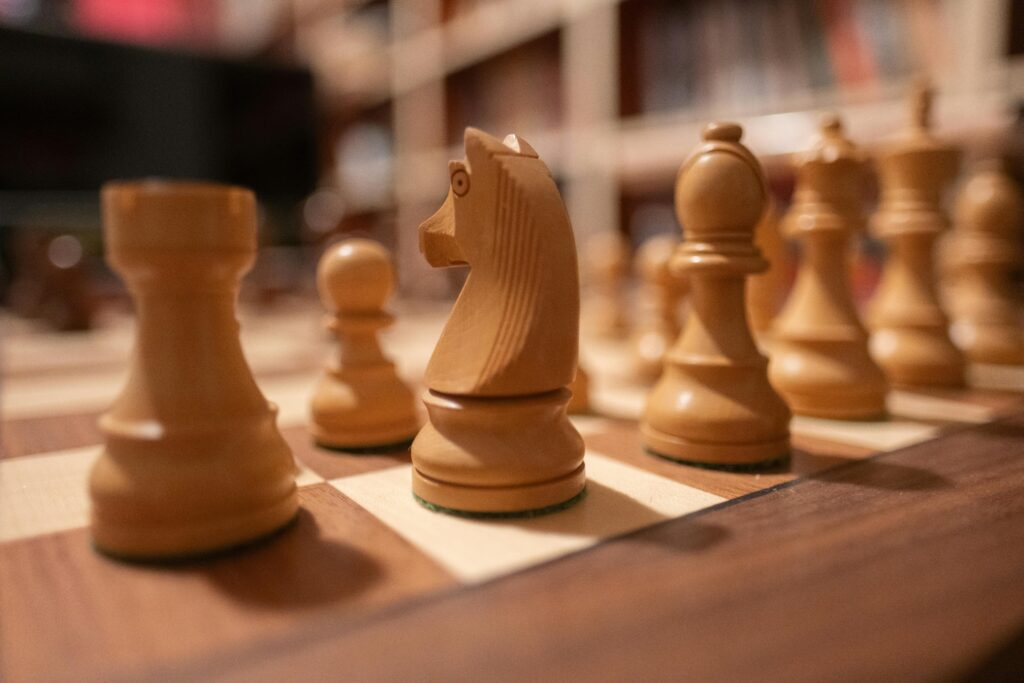
Staunton chess sets explained simply: if you’ve ever played chess — or even seen a chess set — you’ve almost certainly encountered this iconic design without even knowing it.
The horse-headed knight. The cross-topped king. The simple, elegant pawn. These are the pieces that most people picture when they think of chess, and they’ve looked essentially the same for nearly 175 years.
But what exactly is a Staunton chess set? Where did the design come from? Why did it become the universal standard? And what should you look for when buying one?
This guide covers all of it — the history, the design of every piece, the materials, and how to pick the right Staunton set for your level and budget.
Already know what you want? Jump to our picks for the Best Chess Sets for Beginners or Best Wooden Chess Sets in 2026.
Staunton Chess Sets Explained: What Are They?
A Staunton chess set is a specific style of chess pieces — and the official standard for competitive chess worldwide. Every serious club, every major tournament, and every national and international chess federation uses the Staunton design. FIDE, the World Chess Federation, formally recommends it for use in all competition.
The design is instantly recognizable: each of the six piece types has a distinct, functional shape that can be identified at a glance from across the board. That clarity is precisely the point. Before the Staunton design existed, chess sets were beautiful but chaotic — a mess of ornate, artistic styles that often made it genuinely difficult to tell a bishop from a queen during a fast game.
The Staunton design solved that problem in 1849, and has never been replaced.
The History of the Staunton Chess Set
The Problem It Solved
Before 1849, chess sets across Europe and beyond varied wildly in style and form. English sets like the St. George, the Barleycorn, and the Northern Upright were each popular in different regions and clubs, but none was universal. Bishops could resemble elephants or abstract towers. Queens were difficult to distinguish from kings. Knights were sometimes so ornate they were hard to recognize quickly.
As chess clubs and international competitions began to grow throughout the early 19th century, the need for a standardized set became urgent. Players from different countries sitting down to compete needed to be able to recognize every piece immediately — without any prior familiarity with the local design.
The Three Men Behind the Design
The introduction of the Staunton design involved three men: Nathaniel Cooke, John Jaques, and Howard Staunton.
John Jaques was the master craftsman. Working from the existing Northern Upright pattern, he refined and simplified the design — removing decorative features most likely to chip or break, widening the bases for stability, and adding lead weights inside the wooden pieces. He created a set that was both practical and affordable to manufacture at scale.
Nathaniel Cooke, Jaques’ brother-in-law and a publisher by trade, filed the official design patent on March 1st, 1849, and convinced the most famous chess personality of the era to lend his name to it.
Howard Staunton was widely regarded as the strongest chess player in the world from 1843 to 1851. He endorsed the new design publicly, promoted it through his chess column in the Illustrated London News, and signed the first 500 sets by hand. His celebrity gave the design instant credibility across the chess world.
The first sets were made available by Jaques of London in 1849, and the design quickly became the standard. The relatively low production cost brought chess to the masses, and the clarity of the design removed any barrier to international play.
From London to the World
Though the Staunton pattern rose dramatically in popularity during the 19th century, it was not until the 1920s that it became the official standard for tournament play. By the early 20th century, it was adopted by the newly formed FIDE as the requirement for all international competition — a status it holds to this day.
The original design has remained remarkably consistent for nearly 175 years. That’s not inertia — it’s a testament to how well the design was conceived from the very beginning.
The Design of Each Staunton Chess Piece
One of the most important things to understand about the Staunton design is that every piece was designed with a specific purpose: to be immediately identifiable at a glance, proportionate in size to its importance on the board, and stable enough for daily competitive use. Here’s what defines each piece:
The King
The tallest piece on the board, the king is topped with a cross finial — a reference to the cross on the British Imperial Crown. Its height makes it unmissable from any angle. In standard tournament sets, the king stands 3.75 inches tall.
The Queen
Slightly shorter than the king, the queen is crowned with a coronet topped by a small spherical finial (called a monde). The distinction between the king’s cross and the queen’s ball is one of the most important visual cues in the entire set.
The Bishop
The bishop features a rounded head with a distinctive diagonal cut — representing a Western-style mitre, the tall hat worn by Catholic bishops. The cut gives the bishop an immediately recognizable silhouette even at the edge of your peripheral vision.
The Knight
The knight is the most artistically complex piece in any Staunton set and is widely considered the best indicator of a set’s overall quality. It features a carved horse’s head and neck — modeled after the sculpture of the horse pulling the chariot of the Greek goddess of the moon, Selene, that appeared on the east pediment of the Parthenon. A well-made knight with fine facial detail and a flowing mane is the hallmark of a premium Staunton set. Always judge a set by its knight first.
The Rook
The rook features a solid tower shape topped with crenellated battlements — the stepped pattern found on medieval castle walls. It’s one of the simplest pieces to carve, which is why cheap sets often look acceptable at the rook while failing at the knight.
The Pawn
The simplest and smallest piece: a sphere atop a slender column, with a flat collar separating the body from the head. The design is intentionally minimal — pawns need to be distinct from each other only in color, and instantly distinguishable from all other piece types.
What Makes a Quality Staunton Chess Set?
Not all Staunton chess sets are made equal. Here’s what to look for when assessing quality:
The Knight — Judge Everything Else By This
As mentioned above, the knight is the most complex piece to carve and the hardest to fake. A quality set has a knight with clear, expressive facial features, a flowing mane, and clean lines. Budget sets often have flat, vague knight heads that barely resemble a horse. If the knight looks good, the rest of the set almost always does too.
Weighted Pieces
Quality Staunton sets have weighted pieces — traditionally with a lead or steel disc inserted in the base. This adds stability during play, prevents pieces from tipping during fast games, and gives a satisfying, solid feel when you place a piece down. Pieces are typically described as single-weighted, triple-weighted, or quadruple-weighted — the more weight, the more substantial the feel.
Felted Bases
The underside of each piece should be covered with felt. This protects the board surface from scratching, reduces noise when placing pieces, and allows smooth, easy movement across the board.
Wood Type
For wooden Staunton sets, the most common and respected combination is Boxwood (light pieces) and Sheesham/Indian Rosewood (dark pieces). Premium sets use Ebony for the dark pieces — the densest, finest-grained wood available for chess pieces. Budget sets often use Ebonized Boxwood — Boxwood that has been stained black — which looks similar to Ebony at a fraction of the cost.
Piece Proportions
Standard tournament proportions call for a king height of 3.75 inches paired with a board with 2.25-inch squares. The king’s base diameter should be roughly 43–47% of the king’s height. If proportions are off, the board looks and feels wrong — pieces either look crowded or lost on the board.
See our Chess Board Sizes Explained guide for a full breakdown of piece-to-board proportions.
Staunton Chess Sets: Materials Guide
Plastic Staunton Sets
Plastic Staunton sets are the most practical choice for regular club and tournament use. They’re durable, easy to clean, and can handle thousands of games without showing wear. Quality plastic sets are weighted and felted, and meet all FIDE tournament specifications. They’re the standard at US Chess Federation events and most clubs worldwide.
Wooden Staunton Sets
Wooden sets are the traditional choice — and the preferred option for home play, serious collectors, and anyone who wants the full chess experience. The feel of wooden pieces on a wooden board is simply different from plastic, and for many players, it’s what makes the game feel real.
Collector & Antique Staunton Sets
Original 19th-century Jaques Staunton sets are among the most prized items in chess collecting. They can be identified by specific maker’s stamps — early sets often included a small green label or a “Jaques London” imprint beneath the king’s base. Condition, provenance, and completeness all affect value significantly, with some original examples selling for tens of thousands of dollars at auction.
Modern reproduction sets from respected makers attempt to faithfully recreate historical proportions, wood types, and carving details — a more accessible way to own a piece of chess history.
Why Is It Called a Staunton Chess Set?
This is a common source of confusion. The set is named after Howard Staunton, but he didn’t design it. John Jaques almost certainly designed the pieces, and Nathaniel Cooke filed the patent. Staunton’s role was as an endorser and promoter — but given his celebrity status in the chess world of the 1840s, his name was the one that stuck.
Staunton used his dual positions as a chess celebrity and journalist to promote the new set. His endorsement in the Illustrated London News gave the design instant visibility and credibility among serious players. Within a few years, the name “Staunton” had become inseparable from the design itself.
Do You Have to Use a Staunton Set?
For casual home play, you can use any set you like. Themed sets, novelty sets, artistic sets — all perfectly fine for playing with friends or family.
For club play and formal tournaments, Staunton is required. FIDE regulations specify that pieces used in official events must follow the Staunton pattern, and most national federations — including the US Chess Federation — follow the same standard. If you’re playing in any rated or competitive event, a standard Staunton set is non-negotiable.
For learning and practice, Staunton is strongly recommended even at home. Since every book, every diagram, every online platform, and every tournament uses the Staunton design, getting familiar with the piece shapes early removes one more thing you have to think about when you’re just starting out.
Frequently Asked Questions
What is a Staunton chess set?
A Staunton chess set is the official standard style of chess pieces used worldwide — in every serious club, national federation, and international tournament. The design dates to 1849 and features clearly distinguishable pieces: a cross-topped king, a coronet queen, a mitre-cut bishop, a horse-head knight, a crenellated rook, and a simple sphere pawn.
Who invented the Staunton chess set?
The set was designed by John Jaques of London, patented by Nathaniel Cooke, and named after Howard Staunton — the strongest chess player of the era — who endorsed and promoted it. It was first sold publicly in September 1849.
Why is the Staunton design the standard?
The Staunton design solved a real problem: before 1849, chess sets varied wildly and made international play confusing. The Staunton pieces are immediately recognizable, proportionate, stable, and practical to manufacture — qualities that made it the obvious choice for standardization as chess grew into a global competitive sport.
What is the best Staunton chess set for beginners?
For beginners, a quality weighted plastic Staunton set is the most practical starting point — durable, tournament-legal, and affordable. The Chess House Quality Regulation Set and the Best Chess Set Ever are two of the most popular choices. See our full guide: Best Chess Sets for Beginners.
What is the best wooden Staunton chess set?
The Chess House Championship Combo is the most highly rated wooden Staunton set at a beginner-accessible price, using the same piece pattern seen at World Championships and FIDE Olympiads. For a step up, the House of Staunton Club Set is the premium choice. See our full guide: Best Wooden Chess Sets in 2026.
How do I know if a Staunton chess set is good quality?
Start with the knight. A quality Staunton set has a knight with clear, expressive carving — a recognizable horse head with distinct features and a clean mane. Also check that pieces are weighted, felted on the base, and follow standard proportions (3.75-inch king, 2.25-inch board squares).
Are antique Staunton chess sets valuable?
Yes — original Jaques Staunton sets from the 19th century are among the most collectible items in chess. Sets with original maker’s marks, full piece counts, and good condition can sell for significant sums at auction. Modern reproductions by respected craftsmen are a more accessible alternative for collectors who want historical accuracy.
Is the Staunton design used in online chess?
Yes — most major online chess platforms, including Chess.com and Lichess, base their default digital piece graphics directly on the Staunton design. It’s the universal visual language of chess, online and over the board.
Final Thoughts
The Staunton chess set is one of the most successful design solutions in the history of any sport or game. In a single stroke, it replaced a chaotic variety of incompatible styles with a single, clear, functional, and beautiful standard — one that has served players at every level for nearly 175 years without meaningful revision.
Whether you’re buying your first set, upgrading to something premium, or simply curious about the pieces you’ve been playing with, understanding the Staunton design gives you a deeper appreciation of the game itself.
Ready to find your set? See our guides: