
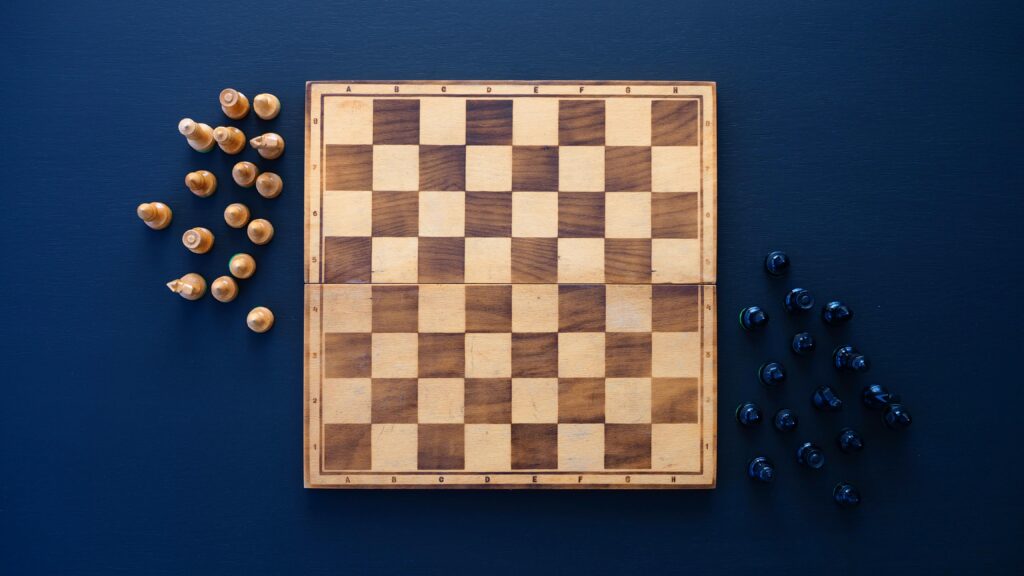
Chess board sizes explained simply: choosing the wrong board size is one of the most common mistakes new players make — and one of the easiest to avoid.
A board that’s too small makes pieces feel cramped and hard to move. A board that’s too large leaves pieces looking lost in the middle of empty squares. Get the size right, and the whole game just feels better — cleaner, easier to read, and more enjoyable to play.
This guide covers everything you need to know: the standard sizes for home, club, and tournament play, how to match your board to your pieces, the FIDE and USCF official specifications, and how to choose the right size for your level.
Looking for a full equipment overview? See our Ultimate Chess Equipment Guide 2026 for boards, pieces, clocks, and more.
Why Chess Board Size Matters
Most casual players never think about board size until something feels off. The pieces look out of proportion. There’s too much empty space around each piece, or not enough room to place them without knocking neighbors over. Time pressure in a blitz game gets worse when you’re fumbling around an ill-fitting board.
The right board size does three things: it makes the position easy to read at a glance, it gives your pieces enough space to be placed and moved comfortably, and it matches the standard you’ll encounter at clubs and tournaments — so you never have to adjust.
Chess Board Sizes Explained: The 4 Main Categories
1. Travel & Mini Boards (Under 15 inches)
Square size: 1.5 to 2 inches | King height: up to 3 inches
Travel boards are compact and portable — designed to fit in a backpack or suitcase. They’re great for playing on planes, trains, or in parks, and many feature magnetic pieces to keep everything in place during movement.
The trade-off is that they’re noticeably smaller than what you’ll play on at a club or tournament. They’re not ideal for serious study or practice, but for casual games on the go, they’re exactly what you need.
Best for: Travel, outdoor games, kids learning the basics.
2. Home & Casual Boards (15 to 19 inches)
Square size: 1.75 to 2 inches | King height: 2.5 to 3.5 inches
Home boards are the middle ground — larger and more comfortable than travel sets, but smaller than the full tournament standard. A 15 to 18-inch board with 2-inch squares is a popular choice for players who want a proper chess experience at home without the footprint of a full tournament setup.
These boards pair well with pieces that have a king height of around 3 inches and look great on a coffee table or side table. They’re not tournament-legal, but for regular home games, friends, and family, they’re a perfectly comfortable size.
Best for: Home play, casual games, display on a coffee or side table.
3. Club & Standard Boards (19 to 21 inches)
Square size: 2 to 2.25 inches | King height: 3.75 inches
This is the size most serious players use for regular practice and club play. A 20-inch board with 2.25-inch squares is the US Chess Federation (USCF) standard, and it’s what you’ll encounter at the vast majority of club nights and rated tournaments across the US.
Getting comfortable on a club-size board early is a genuine advantage. When you’re used to the standard size, you never have to adjust — the position looks the same whether you’re at home or at a tournament.
Best for: Club play, regular practice, anyone who wants to compete.
4. Tournament Boards (20 to 22 inches)
Square size: 2.25 inches (USCF) / 2 to 2.375 inches (FIDE) | King height: 3.75 inches
Tournament boards are the official standard for competitive play. The USCF specifies 2.25-inch squares for sanctioned events, while FIDE specifies a range of 5 to 6 centimeters (approximately 2 to 2.375 inches) for international play.
In practice, most tournament players use a 20-inch vinyl roll-up board with 2.25-inch squares — the most widely available and affordable option that meets all official specifications. These boards are lightweight, durable, and easy to carry to any venue.
Best for: Rated tournaments, competitive club play, serious practice.
The Official Size Standards: FIDE vs. USCF
Understanding the difference between FIDE and USCF specifications helps you buy with confidence.
| Standard | Square Size | Overall Board | King Height |
|---|---|---|---|
| USCF (US tournaments) | 2.25 inches | 20–22 inches | 3.375–4.5 inches |
| FIDE (international) | 5–6 cm (2–2.375 in) | 50–55 cm (19.7–21.7 in) | ~9.5 cm (3.74 in) |
| Recommended standard | 2.25 inches | 20 inches | 3.75 inches |
For the vast majority of US players, the USCF standard is what matters: 2.25-inch squares, 20-inch board, 3.75-inch king. This is the combination found at most US clubs and open tournaments, including the US Open.
How to Match Your Chess Board to Your Pieces
This is where most players go wrong. A board and pieces that don’t fit each other look and feel wrong — even if both are technically good quality on their own. Here’s the rule that makes it simple:
The 75–80% Rule: The base diameter of your king should be 75–80% of the size of your board’s squares.
This gives each piece enough space to be placed and moved comfortably, while keeping the position easy to read — not too crowded, not too sparse.
| King Base Diameter | Ideal Square Size | Board Size |
|---|---|---|
| 1.3 inches | 1.75 inches | 15–16 inches |
| 1.5 inches | 2.0 inches | 17–18 inches |
| 1.75 inches | 2.25 inches | 20 inches (tournament standard) |
| 2.0 inches | 2.5 inches | 21–22 inches |
A quick practical test: Place four pawns in a single square. If they fit comfortably, your pieces and board are well-matched. According to USCF standards, this should be possible with any tournament-standard combination.
Chess Board Size by Player Type
Not sure which size is right for you? Here’s a straightforward guide:
Complete beginner: Start with a standard 20-inch board with 2.25-inch squares. It’s the most widely available size, matches club and tournament standards, and gives you room to grow. You’ll never need to upgrade the board itself.
Casual home player: A 15 to 18-inch board with 2-inch squares works well if you want something that fits comfortably on a table at home. It’s not tournament-legal, but for friendly games it’s perfectly comfortable.
Club player: Go straight to the 20-inch tournament standard with 2.25-inch squares and a 3.75-inch king. Get used to the standard size and you’ll feel at home at any club or competition.
Tournament player: A 20-inch vinyl roll-up board with 2.25-inch squares meets all USCF requirements and is the most practical choice for travel. If you also want something for home, a wooden board with the same square size gives the best of both worlds.
Kids and schools: A 15 to 18-inch board with 2-inch squares and a 3-inch king is the most comfortable size for smaller hands. Many school chess programs use this size for classroom and club play.
See our recommended boards in the Best Chess Sets for Beginners guide.
Board Types by Size: Which Surface Is Right for You?
Vinyl Roll-Up Boards
The practical standard for tournament and club play. Lightweight, durable, easy to roll up and carry, and available in tournament-standard sizes. They lie flat, don’t crease easily, and can handle years of regular use. Most USCF tournaments use vinyl roll-up boards.
Recommended size: 20 inches with 2.25-inch squares.
Silicone Roll-Up Boards
A more modern alternative to vinyl. Silicone boards are spill-proof, easy to clean, and don’t crease at all. They’re becoming increasingly popular among club and tournament players who want something more durable than vinyl.
Recommended size: 20 inches with 2.25-inch squares.
Wooden Boards (Flat)
The classic choice for home and display play. A flat wooden board looks beautiful, stays completely level, and pairs perfectly with wooden or weighted plastic pieces. They’re not as portable as roll-up boards but are the preferred option for players who want a permanent home setup.
Recommended size: 20 inches with 2.25-inch squares for tournament-standard play; larger for display sets.
Folding Wooden Boards
A compromise between portability and the look of a wooden board. Folding boards store their pieces inside and can be transported more easily than flat boards. The main drawback is that lower-quality folding boards sometimes don’t lie completely flat when open.
Recommended size: 15 to 20 inches depending on use.
Travel & Magnetic Boards
Compact boards — typically 12 to 15 inches — with magnetic pieces that stay put during movement. Ideal for playing in transit or outdoors. Not tournament-legal, but excellent for casual play anywhere.
Common Mistakes When Choosing a Chess Board Size
Buying too small: The most common beginner mistake. A 12-inch board might look fine in photos online but feels cramped in person with standard-size pieces. Always check the square size, not just the overall board dimensions.
Mismatching pieces and board: Buying a 20-inch board and pairing it with a 3-inch king leaves too much empty space around each piece. Always apply the 75–80% rule before buying.
Ignoring the border: The overall board size includes the border around the playing area. A 20-inch board has a smaller playing area than you might expect — typically around 18 inches of actual squares. Always check the square size measurement, not just the total board size.
Buying a display size for regular play: Large decorative boards (24 inches and above) look impressive but are awkward to play on. Save those for display and use a proper tournament-size board for actual games.
Frequently Asked Questions
What is the standard chess board size?
The most widely used standard is a 20-inch board with 2.25-inch squares, paired with pieces that have a 3.75-inch king. This is the USCF tournament standard and the size used at the vast majority of US clubs and competitions.
What size chess board do I need for tournament play?
For USCF-sanctioned events, you need a board with squares between 2 and 2.5 inches — the standard is 2.25 inches. For FIDE international events, squares should be between 5 and 6 centimeters. In practice, a 20-inch board with 2.25-inch squares meets both requirements comfortably.
How do I know if my board and pieces match?
Use the 75–80% rule: the base diameter of your king should be 75–80% of the square size. For the standard 2.25-inch square, a king with a 1.75-inch base diameter is the ideal match. You can also try the four-pawn test: place four pawns in one square — if they fit comfortably, your combination is well-matched.
What size chess board is best for beginners?
Start with a 20-inch board with 2.25-inch squares. It’s the tournament standard, widely available, and gives you a consistent size to get used to. If you’re buying for a child, a 15 to 18-inch board with 2-inch squares is more comfortable for smaller hands.
What is the difference between FIDE and USCF board sizes?
FIDE specifies squares of 5 to 6 centimeters (roughly 2 to 2.375 inches) for international play. The USCF specifies squares of 2 to 2.5 inches for US events, with the standard being 2.25 inches. A 20-inch board with 2.25-inch squares satisfies both standards and is the safest choice for any competitive play.
Can I use a small travel board for practice?
Yes, for casual games and learning the basics. But for serious practice, stick to the standard 20-inch size — getting used to the proportions of a proper board makes a real difference when you’re playing in timed or competitive conditions.
How big is a chess board in centimeters?
The standard tournament board is approximately 50 cm x 50 cm (just under 20 inches), with individual squares measuring 5.7 cm (2.25 inches). FIDE specifies a range of 50–55 cm overall, with squares between 5 and 6 cm.
Final Verdict: Which Chess Board Size Should You Buy?
For most players, the answer is simple: a 20-inch board with 2.25-inch squares.
It’s the USCF tournament standard, the most widely available size, and the one that pairs correctly with the standard 3.75-inch king. Whether you’re a beginner, a club player, or a tournament competitor, this is the size that will never let you down.
If you need something for travel, a 12 to 15-inch magnetic or silicone board is a practical secondary option. For home display, a larger wooden board (21 to 24 inches) looks beautiful — just keep the tournament-size board for actual play.
See also: